• Obits
  • Advertising
  • Contact us
  • Business Directory
default-logo
  • Home
  • News
  • Sports
  • Business
  • Entertainment
  • Community
  • Lifestyles
  • Opinion
  • Events
  • Classifieds
IN THE NEWS
Sad day for newspapers
-30- Prince George Free Press closes its doors
Three second-degree murder charges laid in connection with Burns Lake homicides
Triple homicide in Burns Lake
Justice Glen Parrett retiring
CNC suspends dental program intakes, but offers ray of hope
One injured in crash at Ospika and Dufferin
Carson Air employees ‘really skaken up’ following loss of two pilots
Nails being spread on roads near hospital
Police looking for more information regarding stabbing death of Ronald James Larson

UNBC researchers look at gene splicing

Posted On 02 Apr 2015
By : Allan Wishart
Tag: UNBC
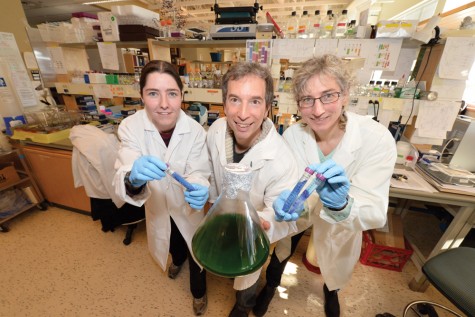
UNBC researchers Elizabeth Dunn, left, Stephen Rader and Martha Stark have found a new way to study gene splicing.

UNBC researchers Elizabeth Dunn, left, Stephen Rader and Martha Stark have found a new way to study gene splicing.

Sometimes the biggest discovery is what isn’t there.

“We were totally surprised that the U1 wasn’t there,” says UNBC Professor of Chemistry Dr. Stephen Rader. “U1 has always been found in other organisms.”

U1 is a specific type of small nuclear ribonucleic acid (RNA), which Rader and his team of researchers found wasn’t in red algae. The group was looking for new ways to study gene splicing.

“Red algae refers to the pigments in them, not the actual colour,” Rader says. “They are actually microscopic, a single cell.”

The genome for red algae was mapped by a Japanese team in 2004.

“We became aware of the work they had done,” Rader says, “and the fact they had only found 27 introns in the red algae.”

Introns are a segment of an RNA molecule which doesn’t have any of the code for proteins in it. The red algae number was, to put it mildly, quite low.

“Human genes have hundreds of thousands of introns. We thought, ‘This is really bizarre. Will the gene splicing mechanism be much simpler in them as well?’”

Because of the large number of introns and splices found in human genes, there is much higher likelihood of defects, which can lead to diseases such as cancer or cystic fibrosis.

Being able to study the gene-splicing mechanism in red algae, Rader and his team hoped, would be much simpler than using other RNA.

“It would be like if a Martian came to Earth and wanted to know how our machinery worked, he could start with an airplane engine or with a bicycle. The bicycle would be a lot easier to start with.”

At first, the UNBC researchers weren’t sure they were reading the data correctly when they couldn’t find the U1.

“It’s associated with certain proteins, so we looked for them, and found they were missing as well. That made us more confident of our findings.”

The team published its work to date in the Proceedings of the National Academy of Science earlier this month, and are ready to take the next steps.

“So far, all we’re done is computational predictions,” Rader says, “Now we have to confirm the findings experimentally.”

They’ll do that by breaking open the algae and grab onto the RNA with molecular tools.

“It would be kind of like reaching into the back of a television, grabbing one of the components, and seeing what it’s connected to.

“The experiments so far have exactly confirmed the predictions.”

He’s also hoping their experimental work will answer another question that popped up when they made their discovery of something that wasn’t there.

“We’d like to know how the algae get by without the U1.”

About the Author
  • google-share
Previous Story

Tributes pour in for Ben Meisner

Next Story

Fire damages house on Inglewood Road

Related Posts

off

UNBC Timberwolves recognize top athletes from past season

Posted On 21 Apr 2015
, By staff1

UNBC Community Care Centre not taking new clients

Posted On 15 Apr 2015
, By Staff Reporter

UNBC faculty dispute goes to binding artbitration

Posted On 01 Apr 2015
, By Staff Reporter

UNBC students doing survey on impact of Canada Winter Games

Posted On 25 Mar 2015
, By Allan Wishart

Online Edition

Archive Edition

Current Online Issue


RECENT

POPULAR

COMMENTS

REVIEW: The Secret Mask brilliantly done

Posted On 01 May 2015

Prince George Gnats start home rugby season on Saturday

Posted On 01 May 2015

Sub Zero on track

Posted On 01 May 2015

Hospice asks government for more funding

Posted On 27 Mar 2003

Auto dealer charged with 'deceptive practices'

Posted On 03 Oct 2014

LETTER: Not sorry for being a teacher

Posted On 27 Jun 2014

From reading about the author you have...

Posted On 05 May 2015

Are you sure you are a reporter? Becuase...

Posted On 04 May 2015

Teresa Mallam may have won the Canadian...

Posted On 04 May 2015

Popular

Hospice asks government for more funding

No Responses.

Auto dealer charged with 'deceptive practices'

No Responses.

LETTER: Not sorry for being a teacher

No Responses.

Contact us

Prince George Free Press

Address: 1773 South Lyon Street
Prince George, B.C., V2N 1T3
Phone: 1-250-564-0005


Proudly part of the Aberdeen Publishing group. Click for more on Aberdeen Publishing.

Archives

Search

Recent Posts

  • REVIEW: The Secret Mask brilliantly done
  • Prince George Gnats start home rugby season on Saturday
  • Sub Zero on track
  • Arm wrestlers, start your training
  • NDIT still focused on pine beetle recovery
© Prince George Free Press - Powered by Aberdeen Publishing Terms of Use | Privacy Policy