Previous Story
A living book
Posted On 30 Mar 2015
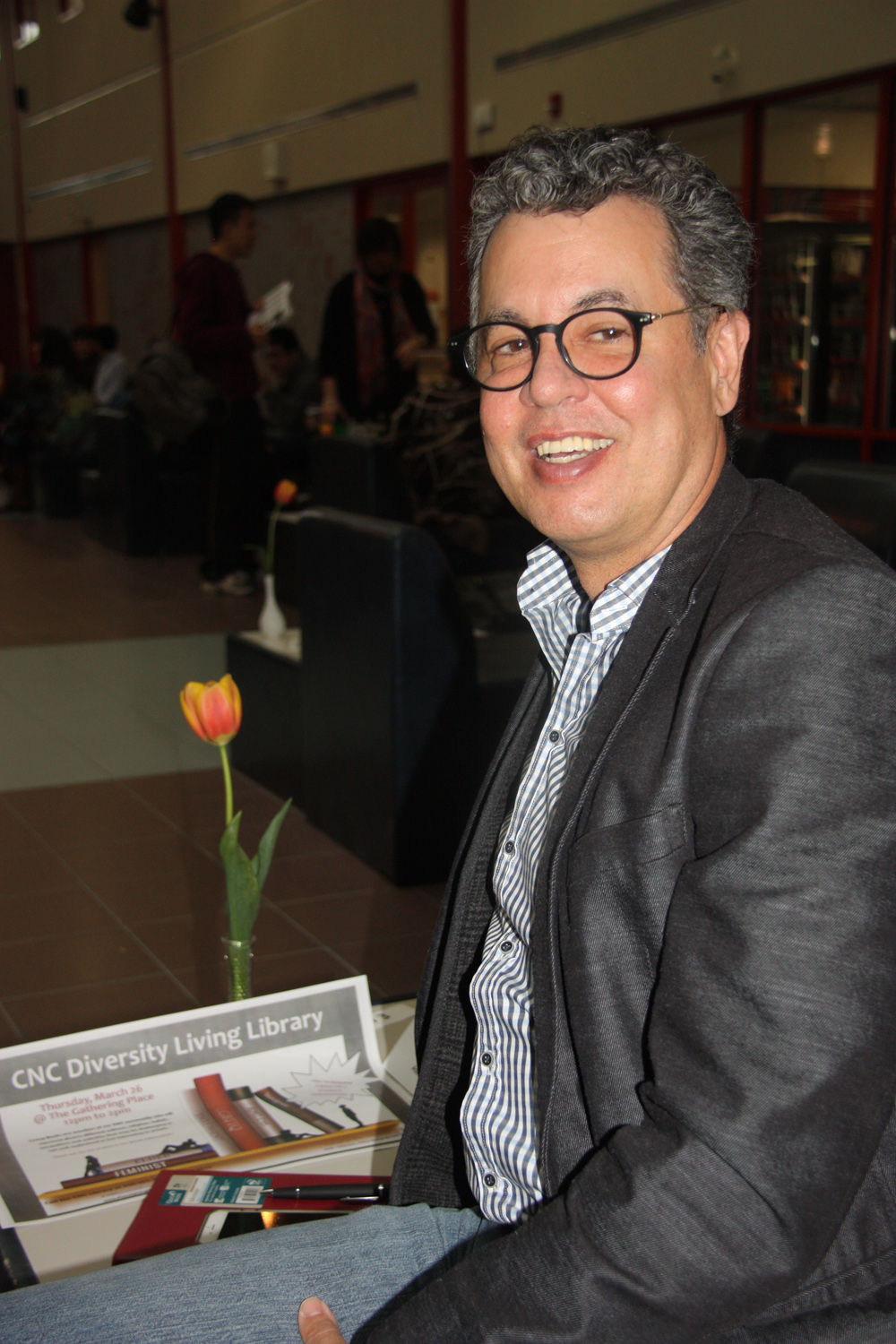
Eric Weissman Ph.D. is an “open book” Thursday at the Diversity Living Library event at College of New Caledonia. A visual storyteller, educator, playwright, documentary and filmmaker, Weissman who was addicted to drugs for decades and often reduced to homelessness, was one of several presenters representing different walks of life who participated in the “live book” sessions. Teresa MALLAM/Free Press
When you reach rock bottom you still have farther to fall.
Just ask Dr. Eric Weissman.
What once was his worst nightmare turned into his greatest asset, he said. The humbling experience of being a destitute, drug addict who eventually became homeless gave him the knowledge, courage and determination needed to help others find a better path in life.
He’s interviewed and filmed dozens of people for documentaries about people’s struggles on the streets. Today the 54-year-old professor of sociology at the College of New Caledonia, gives talks on his roller coaster life to educators, students and the general public and shares the lessons he’s learned.
His work in the field has been lauded by his peers.
His 13-year multimedia project which compares government housing with “shanty towns” set up by homeless residents in Toronto won him the 2014 Distinguished Dissertation Award from the Canadian Association of Graduate Studies.
One thing that sets Weissman apart from others who have gathered information and suggested solutions to the problems of society, is that Weissman has walked the walk. He’s lived in camps in the U.S. where people were “fighting for their right to space” and he’s spent nights sleeping on a bar pool table when he’d run out of housing options.
He obtained his doctorate from Concordia in Montreal.
“I do what a lot of PhDs do now, I travel with my project,” said Weissman at CNC’s Diversity Living Library event last Thursday. He was one of the “open books” that people could “sign out” and spend 15 minutes learning about their diverse cultural, racial and social backgrounds.
Weissman’s life started out normally enough with no hint of the chaos to come.
“I came from a close-knit Jewish family, he said. “My parents were divorced but we were all still close.”
All that changed in the late 1980s when as a university student, Weissman developed drug addictions that began to take over his life. He’d already smoked hashish in 1979 but now he was doing more potent illicit drugs.
He recounts one horror story after another.
“I was going to school and working full time at a gallery and clothing store, and I was expected to get straight A’s (he did.) The only way I could do that was to get high and stay high. So I was heavily into drugs from 1987 to 1996 – marijuana, cocaine, heroine, I did it all, sex, drugs and rock ‘n’ roll. I often lived with (exotic) dancers who had the same hours and drug addict lifestyle I did,” he said.
“When I was doing drugs I was surrounded by Toronto’s after-hours crowd in a world that meant getting up at 1 or 2 o’clock in the afternoon and going to the bar, then the cycle would start all over again. One day I was doing this great big line of coke and I actually saw my own septum blown up, it blew right out of my nose and hit the wall.”
That shocked him – but it didn’t stop him.
“I’d borrowed money from the owner to run the gallery and I’d spent all that on drugs, and I’d spent just about everything else that people had lent me (to repay drug debts) because they didn’t want to see me get hurt. Everything I did was directed at getting high.’
His financial crash came long before his personal crash.
“When I ran out of money, I went underground. I had to go on welfare because I was homeless, not in the way we understand it today, not living on the streets, but sleeping on people’s couches. Finally in 1994, for six months, I was living above a bar – they thought with my connections I could bring in crowds – until it was closed down. I spent my nights sleeping on the pool table.”
His episodes of being homeless became more frequent, he said. When he finally went on welfare, he was living in an apartment.
“I was lying there on the floor, on my futon, and I could hear footsteps coming towards the door. I thought it was the drug dealers I owed money to and that it would finally be over. There’s this despair that’s been chronicled by lots of people in this situation – and that was my moment of despair.”
Weissman taps his chest.
“Right now, under my jacket, I can still feel the goose bumps. I’ve been clean and sober for 19 years but the feeling doesn’t go away. So when the door opened, instead of ‘Diablo’ (drug dealer) it was my sister who had come looking for me. There were tears in her eyes and because I was lying on the floor below her, as she cried, one of her tears hit me on the face.
“She said, ‘Do you need help?’”
Weissman told her he did. That was the turning point.
“It was not a spiritual awakening. My sister was in the theatre and film industry and she got me a doctor who’d helped some actors she knew. He got me into an addiction treatment centre in northern Ontario. I was sober for a couple of months, then I relapsed. On January 1, 1995, at 10 minutes after 12, I had my last drink, did my last line of coke and took my last toke.”
Weissman said he knew the drugs would last 72 hours in my system and that they would be doing a drug test before he entered the treatment facility, so he figured he had time, one last time, to engage in his guilty pleasures.
He entered a men’s recovery home located on the Rideau where he kept busy writing a T.V. series and most importantly, working on addiction problem and recovery. He felt alone.
“I was the only Jewish guy in there, I learned the 12 steps and I got a sponsor.”
He started smoking hashish in 1979.
“Marijuana was the hardest drug for me to give up, harder than all the other hard drugs. The only thing harder for me to give up was cigarette smoking,” he said.
Weissman estimates his drug habit over 15 years likely cost him half a million dollars. It cost him everything he had.
“There’s all the money gone, but then there’s all the damage you do to your family and your friends. Surprisingly it was not the money, or the horrible crash after the high that put a stop to it all.
In 1994, two cathartic events changed everything.
“My girlfriend left me and a good friend was murdered. Another friend and I wrote a play about what possibly could have happened to her and there was an option to pick it up and produce it but I used whatever decency we had left and didn’t (sell) the story. It was on a floppy disc and I just read it again recently because CNC has the technology to still be able to do that.”
It took time in treatment centres and rehab to clean up his act, but the reward has been long time sobriety, says Weissman who has created a new website that brings together actions to create conversations around social issues raised by inequality, poverty and homelessness.
For more information visit www.therefelexivityproject.com.